Alpine Besseya Veronica besseya Plantain family (Plantaginaceae)
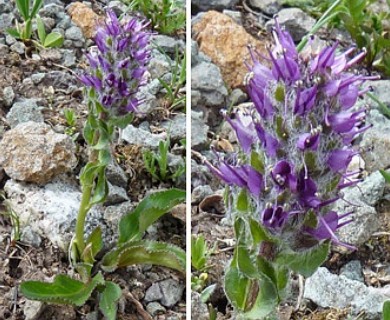
Besseya (Veronica besseya) is a minute and exotic addition to the . It grows from 2-8 inches tall and is moderately to (often) quite hairy. Veronica besseya is found in just a few western states. It is one of many plants that Charles Parry discovered for science. He did so in 1861 in the "headwaters of South Clear Creek [Colorado]."
nearly , 2-8" tall, stems simple, erect; herbage very hairy to . with about 1/2" long, 1-2+" long and 3/4 to 1 1/2" wide, to , . , very small, . dense and very hairy. white hairy. violet to purple, 1/5 to 1/3" long. a to about 1/5" long, .
orbicular -- Circular or nearly circular in outline.
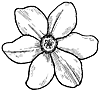
corolla -- The name for all the petals of a flower taken together.
alternate -- leaves alternate along the main stem and
are attached singly.
A perennial plant lives and blooms for many years.
cauline leaves -- leaves growing on a stem and especially on the upper part.
A herb is a plant whose stems die back to the ground in the winter.
basal leaves -- a leaf that grows lowest on the stem of a plant.
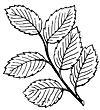
ovate -- Oval, egg-shaped, with a tapering point.
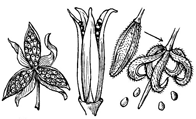
capsule -- a type of simple, dry fruit produced by many species of flowering plants. In
most cases the capsule splits apart to release seeds.
tundra -- Land above tree line characterized by a short growing season, intense sun
and wind, thin soils, very high snow fall and high rain fall. Contains low
growing sedges, grasses, dwarf shrubs and herbs.
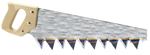
Like the teeth on a saw, leaves and other surfaces can have toothed edges.
fruit -- any seed-bearing structure in flowering plants.
It is formed from the ovary after flowering.
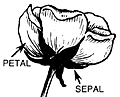
Usually green, sepals typically function as protection for the flower in bud,
and often as support for the petals when in bloom.
sessile -- attached without a stalk. For example, a leaf that clasps the stalk. A petiolate leaf has a stalk.
elliptic -- Oval, with no point or a very short point.
scape -- a long, leafless flower stalk coming directly from a root.
The tulip has a scape.
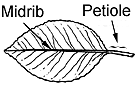
petiole -- the stalk of a leaf.
An inflorescence is a group or cluster of flowers arranged on a stem.
blade -- Just the flat part of a leaf. Not the stem.
glabrous -- smooth, glossy, having no bristles or hair-like structures. Bald.
alpine -- above the tree line. Thin soil, rocks, short growing season, frost, winter snow.