Al Schneider's Rocky Mountains Plant Descriptions

American Alpine Speedwell
Veronica wormskjoldii
Plantain family (Plantaginaceae)

Veronica wormskjoldii has a wide range of blooming times, habitats, shapes, and sizes. It blooms from June into September, from high to areas. It is sometimes quite slender and only a few inches tall but can grow to 14 inches and often grows in colonies of many plants. It always has tiny, dainty flowers easily overlooked. This Veronica is inconspicuous but very common along trails. Veronica is native to much of northern and western North America. The name Veronica is derived from the Greek phero, "I bring" and nike, "victory," in reference to the plant's healing powers. It is also believed that the Veronica recognizes St. Veronica, who is said to have given Jesus her veil to wipe his face as he carried his to Golgotha.
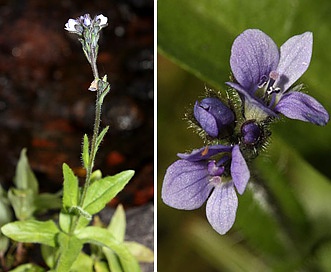

©2011 Walter Siegmund

Description

, 2-10" tall, with hairy, stems. Grows from system of shallow . , elliptical to , or slightly , stalkless and often -hairy. Several minute blue-violet saucer-shaped flowers in short congested clusters. Flowers comprised of 4 broad spreading , 4 , and 2 . Flowering stalks as plant goes to seed. are flattened, hairy, heart-shaped .

Field Marks

Blue saucer-shaped flowers with opposite leaves.

© Al Schneider

silky -- Covered with fine soft hairs, with a lustrous sheen. Satiny to the touch.

An entire leaf has smooth edges. Not toothed or lobed.

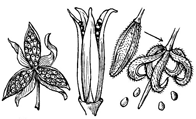
capsule -- a type of simple, dry fruit produced by many species of flowering plants. In most cases the capsule splits apart to release seeds.

A perennial plant lives and blooms for many years.

lobe -- A rounded parts of a leaf (or other organ).

A herb is a plant whose stems die back to the ground in the winter.

alpine -- above the tree line. Thin soil, rocks, short growing season, frost, winter snow.

ovate -- Oval, egg-shaped, with a tapering point.

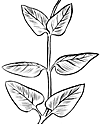
In an opposite leaf arrangement the leaves come in pairs with one leaf on each side of a stem.

cross -- To make something interbreed. The act of hybridization.

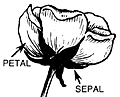
Usually green, sepals typically function as protection for the flower in bud, and often as support for the petals when in bloom.

fruit -- any seed-bearing structure in flowering plants. It is formed from the ovary after flowering.

terminal -- Located at the end (the tip or the apex).

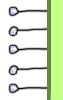
Glands are plant structures that secrete liquids, salts or other substances. Glands often appear as hairs with a drop of liquid at the end.

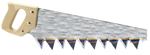
Like the teeth on a saw, leaves and other surfaces can have toothed edges.

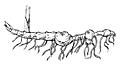
rhizome -- root-like stems that may either grow horizontally at the soil surface or in other orientations underground.

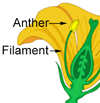
The anther is a pad at the end of the stamen that holds the pollen.

elongate -- long and thin, slender.

genus -- A subdivision of a botanical Family in which all members have a significant number of similar characteristics.

oblong -- Having an elongated form with somewhat parallel sides. Rectangular.

meadow -- Large grass and wildflower filled area with few, if any, trees.