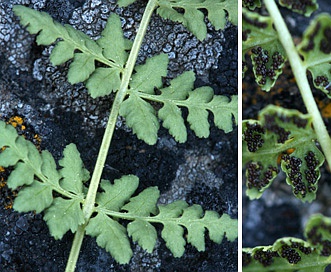
Oregon Woodsia Woodsia oregana Cliff Fern family (Woodsiaceae)
This dainty fern is often found in moist cliffs or dry shaded places or talus slopes with various shrubs from the Pinyon-Juniper community to the high mountain spruce-fir community. Woodsia oregana is similar to Cystopteris fragilis but the latter is less tufted, more at home in dryer conditions, and without conspicuous . Woodsia oregana was first collected for science in the Dalles of the Columbia River, Oregon in the mid 1800s.
Leaves to 10" long (including ), in tufts, smooth to . dark red-brown near base, lighter above. Leaf 2-6" long egg-shaped or triangular, . Individual segments often or cleft near the base and margins slightly curved. cases on the veins on back of .
pinnatifid -- A leaf shape that is pinnately lobed but not cut all the way to the axis.
pinnae -- the primary segments of a compound leaf.
spores are produced by ferns, horsetails, and other primitive plants.
Spores are like tiny seeds, but they lack food for the plant embryo.
Because spores are easily carried aloft by the wind, they allow ferns
and horsetails to reproduce asexually across considerable distances.
persistent -- When the leaves of a plant fail to fall off in the fall they are persistent.
Flowers that stay around after fruiting would be persistent.
Glands are plant structures that secrete liquids, salts or other substances.
Glands often appear as hairs with a drop of liquid at the end.
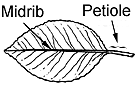
petiole -- the stalk of a leaf.
blade -- Just the flat part of a leaf. Not the stem.
leaflets -- Each little leaf-like thing in a compound leaf is a leaflet.